Sunday, 28 September 2014

The Carbon brief

The website The Carbon Brief claims that it:

reports on the latest developments and media coverage of climate science and energy policy, with a particular focus on the UK. We produce news coverage, analysis and fact checks, and publish a daily and weekly email briefing. 

Its latest article, Your questions on climate sensitivity answered, strangely tells us that the value of the Climate Sensitivity, the expected rise in mean temperature of the earth’s surface given a doubling of CO2 concentration from the level immediately prior to the industrial revolution (and assuming other things are equal), doesn’t actually matter—despite saying that Climate Sensitivity is “at the heart of climate science”.

I wrote about Climate Sensitivity here, noting the astonishingly wide—uselessly wide—range of estimates. Recent studies have produced estimates at, or beneath, the lower range as stipulated by the International Panel on Climate Change (IPCC). This is unsurprising, since there has been no global warming since the mid- to late-1990s, but clearly something The Carbon Brief would rather ignore.

I made the following comment beneath the article, which attracted many ‘likes’ before it was deleted:

Why did you neglect to mention that the IPCC reduced its lower bound on climate sensitivity in its last report, and no longer feels able to offer a central estimate?

Despite the billions spent on research, climate scientists are no closer to "pinning down" this quantity "at the heart of climate science" after 25 years. Some might rate that a conspicuous failure.

I think the first sentence is a pretty reasonable question for a site that would inform members of the public with an air of authority. The second sentence is a factual observation, which many members of the public might find surprising, and some concerning; even, a “conspicuous failure”. Scientific study is meant to deliver increasing precision in our understanding of nature, of course.

According to The Carbon Brief’s comments policy, "vigorous debate is fine”. Really? I wonder why they would delete my post? Could it point to inconvenient truths?

Saturday, 1 February 2014

Open letter to the Prince of Wales

Your Royal Highness,
The news media have drawn attention to a speech you gave recently in which you described climate change “deniers” as “headless chickens”. There is a lot one could say about these descriptions. Not wishing to be openly censorious and certainly without stooping to crude insult, let me merely remark that they are inapt. Instead, let me focus on your frankly admitted bafflement, that has led you to this strange description. You said:
It is baffling, I must say, that in our modern world we have such blind trust in science and technology that we all accept what science tells us about everything – until, that is, it comes to climate science.
Scientists make observations, from which they deduce laws — never more than a temporary best description of phenomena, to be refined or overthrown by subsequent observations — which can be used to make predictions about subsequent events: with greater or lesser success, according to the maturity of the field.
The key parameter in the field of investigation of the “greenhouse effect” (poor metaphor, but we’re stuck with it), which may lead to global warming due to human emissions of carbon dioxide (CO2) in particular, is the “climate sensitivity”. This is the amount by which the earth’s surface can be expected to warm, on average, given a doubling of atmospheric CO2 from pre-industrial levels. The latest report (AR5, in 2013) of the International Panel on Climate Change (IPCC) estimates that its value lies somewhere between 1.5ºC and 4.5ºC. The previous report (AR4, in 2007) estimated that the value lies between 2.0ºC and 4.5ºC. The lowering of the lower bound estimate is not surprising, given that the earth’s surface did not warm in the six-year interval between the reports (indeed, not for 12-17 years now, depending on which of the four main global temperature series you follow). What is noteworthy, is that this demonstrates that climate science is a field which is moving backwards. If you would have placed “blind trust” in climate scientists in 2007 that the climate sensitivity could not be less than 2ºC, your faith would have been misplaced. The current range of estimates is exactly the same as that given in the IPCC’s first report in 1990. Except then, the IPCC felt able to give a central estimate (of 2.5ºC) because the results of different investigators clustered around that value. Now, the IPCC does not feel able to offer a central estimate, because results are scattered. (In fact, most recent studies are towards the low end.) So climate science has made less than no progress, in 23 years of lavish funding, in narrowing down this key value, required for prognostication, where estimates vary by a factor of 3.
Now let us turn to other branches of science and technology, which you say are treated differently; in which people repose “blind trust”. Let’s take another value, the speed of light in a vacuum. Scientists say it’s 299,792,458 metres per second. Not 299,792,457 metres per second, nor 299,792,459 metres per second. And not “somewhere in the range 200-600 million metres per second, we’re not really sure”. That’s just as well, because if I get injured back-country skiing this week (I know that was also a pastime of yours), I’d like to be able to use a GPS device to report my position with a precision of a few metres, rather than “somewhere in the vicinity of planet earth”. Since I’ve relied on GPS many times, in non-life-or-death situations, I feel able to trust it, and by implication measurements of the speed of light, when the chips are down.
Just one more example. The acceleration due to gravity reported by scientists, at sea level on the equator, is 9.78 metres per second per second. Not 9.77 metres per second per second, nor 9.79. And not somewhere between 5 and 15. Precise calculations taking into account latitude and altitude can provide accurate figures for other places. Just as well, as the 747 currently conveying me across the Atlantic would either plunge to earth or go into orbit if there were uncertainty of a factor of 3. I’ve done this lots of time before though (and I know you travel by air even more than me, notwithstanding the CO2 emissions), so I have trust in the Boeing engineers and the scientists who provided them with estimates of the acceleration due to gravity.
Back to climate science. Would I trust scientists  — whose poor knowledge, of what they claim is the key variable in their field, is actually moving backwards — to inform politicians who would load the British economy with billions of pounds of costs and place millions of your future subjects in fuel poverty, even as British winters are not warming? No sir, I would not.
Respectfully yours,
Headless Chicken.

Sunday, 13 May 2012

Thought for the Day

Thought for the Day is a five minute slot on BBC Radio 4's Today programme, during which banal platitudes are recited by a cleric. The BBC uses it as an opportunity to "celebrate diversity", by inviting Christians, Jews, Muslims, Buddhists, Hindus and Sikhs to hold forth; always provided that they don't stray from the moral certitudes of the BBC.

The programme serves a very useful function for me: when the dread words "and now it's time for Thought for the Day" issue from the alarm radio, instantly roused from my torpor, I scramble to hit the off button and head for the shower. Without it, I would be late for work habitually.

But on Friday, I was too late. The speaker was John L. Bell, a minister of the Church of Scotland and BBC regular (despite having been caught lying on air about an alleged Muslim conscript in the Israeli army, allegedly jailed for allegedly refusing an order to shoot Palestinian children).

The talk, on the subject of men being more evil than women, was enlightening for me personally. In the eyes of Rev. Bell, my evil can be bracketed with that of Bashar al-Assad, Adolf Hitler, members of paedophile gangs and organisers of slave labour. All because I don't believe there is persuasive evidence that mankind is causing catastrophic climate change, and have the temerity to say so. Truly, I am damned. I may as well take up murder, rape and genocide.

Here is the talk:

http://www.bbc.co.uk/programmes/p00sc633

Wednesday, 25 April 2012

Biased BBC, Part 3716

The Poet Laureate, Carol Ann Duffy, has edited an anthology of 60 poems to celebrate Her Majesty's diamond jubilee; one for each year of her reign. BBC Radio 4 Today, its flagship current affairs programme, has decided to broadcast three of them. On Tuesday, it broadcast the poem for 1985, Another Country by the acclaimed left-wing poet and professional northerner Sean O'Brien. You can listen to it here, at 1:19:50. You will notice that it passes without comment (unless you can call the reverential silence at the conclusion a comment).

The subject was the year long miners' strike, and anyone old enough to have been aware of current affairs at that time would affirm that it was the defining political event of that year, or any other in decades, closing one era in British political, social and economic history (wherein trades union leaders were as wearily familiar as premiership footballers, and much more important) and opening another (wherein Britain ceased to plummet down economic league tables).

Predictably, the poem depicts southerners, and by implication anyone who supported the government of the day, as selfish, callous and wicked. There is, of course, no mention of, nor allusion to, the facts that:

  • the mines were heavily subsidised to produce coal that was surplus to requirements
  • the National Union of Mineworkers had shown no compunction in allowing the lights and everything else to go out during two strikes in the 1970s (compelling the government, which fell as a result, to restrict industry to a 3-day working week)
  • the NUM leadership refused to hold a nationwide ballot of its members to approve strike action, as its own constitution demanded
  • large numbers of miners refused to strike from the beginning (for example 20,000 out of 27,000  miners in Nottinghamshire voted against strike action in their own ballot)
  • the Trades Union Congress (TUC) refused to sanction the strike
  • the NUM organised phalanxes of 'flying pickets' to intimidate workers at plants using coal into not working.
Now O'Brien can write whatever poems he likes, and it's all the same to me. But in picking this poem, in 3 out of 60, and allowing it to pass without comment, the BBC has failed in its duty of impartiality to the public who are supposed to own it, preferring to build relentlessly on Guardianista mythology. Nobody under about 40 relying on the BBC would know any different. That's wrong, and it's scary.

Saturday, 3 March 2012

Toast of Surrey

Excellent time at the Yvonne Arnaud Theatre (patron: Consult Hyperion) last night!

Scanned Image 120630000

Wednesday, 29 February 2012

The BBC manufactures news

Here is the BBC Radio 4's "The World This Weekend" from last Sunday.

http://www.bbc.co.uk/iplayer/episode/b01cj83k/The_World_This_Weekend_26_02_2012/

For those who don't know, it's BBC Radio's flagship current affairs programme, broadcast on Sunday lunchtime. It consists of a five minute news bulletin, followed by 25 minutes of discussion, interviews and analysis.

The second item on the news was that an ex-head of the National Health Service (appointed by the previous government), Nigel Crisp, "has told this programme" that the government's NHS reforms are a mess that will set the service back (etc, etc). And, sure enough, he said those things (amidst quite a lot that was considerably more emollient) in a segment after the news. His ex-boss, Labour's John Hutton, was also a part of the discussion and the tenor of his remarks was actually quite supportive of the coalition government's stance. I'd regard that as slightly more newsworthy: ex-Labour minister agrees with the Tories. Which seems to suggest that the BBC is more interested in highlighting anti-government views than pro-government views.

But that is incidental to my main point: short of John Humphrys running amok with a pump-action shotgun, what happens inside a BBC studio is not the news. On any proposition, it must be trivially easy to get somebody who used to be important to vent on the radio, for or against. There is an ex-senior civil servant who disagrees with a government policy. Big deal. If doctors plan to strike because of the reforms, that is news. If some clause of the government's bill gets voted down in parliament, that is news. Something has happened in the outside world, and it affects the public at large.

Of course, none of this would bother me if I weren't forced to pay for the BBC's inflated sense of importance and its tendentious news presentation.

Wednesday, 8 February 2012

From the sublime to the ridiculous

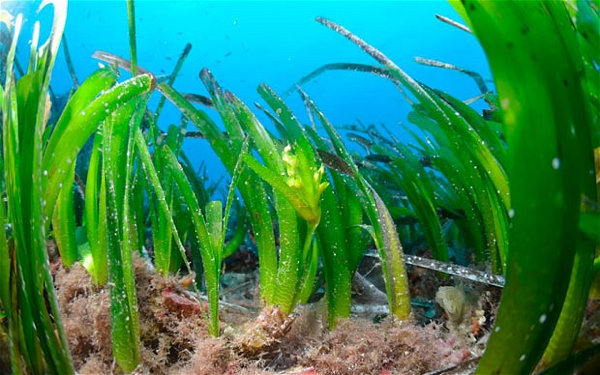
Great science story in the Telegraph today: a 'new' oldest group of organisms on earth has been found: they're somewhere between 12,000 and 200,000 years old (most likely around 100,000 years). Each spans 10 miles and weigh more than 6,000 tons! They're sea grasses in the Mediterranean, as here:

NewImage

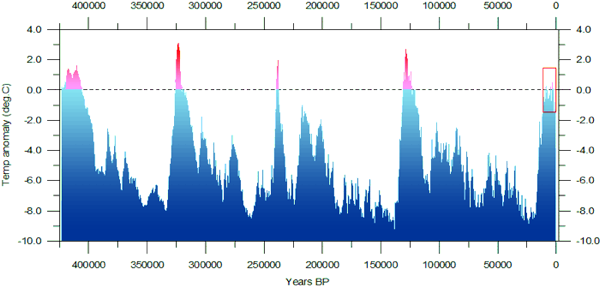
Great work by Professor Carlos Duarte of the University of Western Australia. Then he goes and spoils it all by claiming "If climate change continues, the outlook for this species is very bad". What? At 200,000 years, the things have lived through the better part of two full-blown ice ages! If they're over about 130,000 years old, they lived through the last interglacial, which was nearly 3ºC or about 5ºF warmer than today. See this temperature reconstruction from the Vostok (Antarctica) ice core:

NewImage

Even at 12,000 years old, they'd have seen some of the last full-blown ice age. And they'd have lived through the Holocene climate optimum (around 8,000 and 7,000 years before the present) and the Minoan, Roman and Medieval warm periods: all warmer than at present, as shown by this Greenland ice core:


NewImage

You don't get beyond your 12,000th (or 100,000th or 200,000th) birthday without being just a little bit adaptable [rolls eyes heavenwards].