Excellent time at the Yvonne Arnaud Theatre (patron: Consult Hyperion) last night!
Saturday, 3 March 2012


Wednesday, 29 February 2012
The BBC manufactures news
Here is the BBC Radio 4's "The World This Weekend" from last Sunday.
http://www.bbc.co.uk/iplayer/episode/b01cj83k/The_World_This_Weekend_26_02_2012/
For those who don't know, it's BBC Radio's flagship current affairs programme, broadcast on Sunday lunchtime. It consists of a five minute news bulletin, followed by 25 minutes of discussion, interviews and analysis.
The second item on the news was that an ex-head of the National Health Service (appointed by the previous government), Nigel Crisp, "has told this programme" that the government's NHS reforms are a mess that will set the service back (etc, etc). And, sure enough, he said those things (amidst quite a lot that was considerably more emollient) in a segment after the news. His ex-boss, Labour's John Hutton, was also a part of the discussion and the tenor of his remarks was actually quite supportive of the coalition government's stance. I'd regard that as slightly more newsworthy: ex-Labour minister agrees with the Tories. Which seems to suggest that the BBC is more interested in highlighting anti-government views than pro-government views.
But that is incidental to my main point: short of John Humphrys running amok with a pump-action shotgun, what happens inside a BBC studio is not the news. On any proposition, it must be trivially easy to get somebody who used to be important to vent on the radio, for or against. There is an ex-senior civil servant who disagrees with a government policy. Big deal. If doctors plan to strike because of the reforms, that is news. If some clause of the government's bill gets voted down in parliament, that is news. Something has happened in the outside world, and it affects the public at large.
Of course, none of this would bother me if I weren't forced to pay for the BBC's inflated sense of importance and its tendentious news presentation.
Wednesday, 8 February 2012
From the sublime to the ridiculous
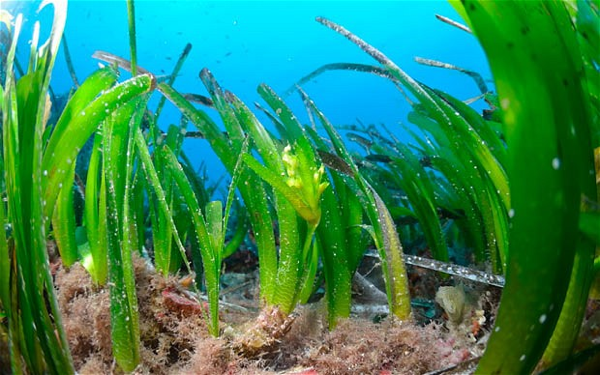
Great science story in the Telegraph today: a 'new' oldest group of organisms on earth has been found: they're somewhere between 12,000 and 200,000 years old (most likely around 100,000 years). Each spans 10 miles and weigh more than 6,000 tons! They're sea grasses in the Mediterranean, as here:
Great work by Professor Carlos Duarte of the University of Western Australia. Then he goes and spoils it all by claiming "If climate change continues, the outlook for this species is very bad". What? At 200,000 years, the things have lived through the better part of two full-blown ice ages! If they're over about 130,000 years old, they lived through the last interglacial, which was nearly 3ºC or about 5ºF warmer than today. See this temperature reconstruction from the Vostok (Antarctica) ice core:
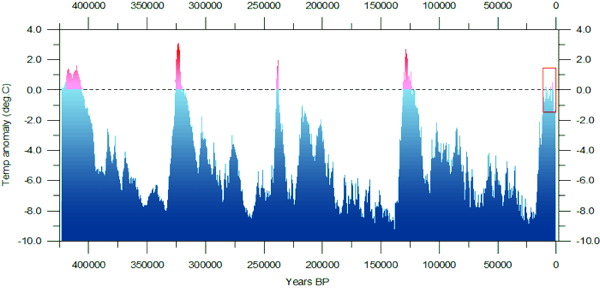
Even at 12,000 years old, they'd have seen some of the last full-blown ice age. And they'd have lived through the Holocene climate optimum (around 8,000 and 7,000 years before the present) and the Minoan, Roman and Medieval warm periods: all warmer than at present, as shown by this Greenland ice core:

You don't get beyond your 12,000th (or 100,000th or 200,000th) birthday without being just a little bit adaptable [rolls eyes heavenwards].
Saturday, 14 January 2012
Words that make me gag
Is it just me, or has the phrase "policy maker" (even worse, sometimes the word "policymaker") gone from 0 to 100 uses per day on the BBC, and like media, in the last five years or so?
The most frequent use, it seems to me, is by self-righteous, self-styled "campaigners", lobbed softball questions on the Today programme, demanding that policy makers do this, that or the other thing, of which BBC-types would generally approve.
The very words make me retch. The implication is of a group of people, a class apart, possessed of preternatural ability, in dialogue with journalists and lobbyists, dreaming up things that are supposedly good for the hoi polloi. The only policy makers should be the self-same hoi polloi. The apparatchiks of political parties might offer up draft policies, for the consideration of the masses at election time or in referenda. But only the people should make policy.
My google searches on "policy maker" yield most mentions for members of the Bank of England Monetary Policy Committee and their counterparts at the US Federal Reserve. I'm not sure that much can be derived from google searches anymore, since they seem highly personalised, but certainly those people fit my definition very well, as people with executive authority who seem beyond democratic accountability. Their counterparts are now openly the unelected leaders of Greece and Italy, as nominated by Berlin, Paris and Brussels.
The price of freedom is eternal vigilance.
Tuesday, 27 December 2011
Marcus Brigstocke, comedian and propagandist
According to the comic‘s official website:
[BBC] Radio 4 has become a second home for Marcus.
Here‘s how he treats his audience (his emphasis, not mine), on the subject of climate change:
I could have written a two-hour stand-up show about climate change quite easily by now but there is absolutely no point because the only people who would come and see it already agree with me. So the approach I’ve taken is to drip feed it into everything that I do, whenever I’m on the radio or doing a stand-up show on any subject, to try and keep it in there just a little bit. People are on to me, it’s no sleight of hand — they know what to expect when I appear. In terms of creating comedy one of the easiest routes has been to mock the people who think that it’s not happening, because I find them easily mock-able. They will say a great deal but when questioned they haven’t read anything.
So, mouthy Marcus, drama degree dropout, reckons he‘s read and understood more relevant material than thousands of professional engineers who have had to understand the atmosphere in order to, you know, make things work (like me) and who happen to hold a contrary opinion (like me). Yeah, right! Still, our competing claims to expertise, and those of all others, are completely immaterial on any question of science: which is why the motto of the Royal Society is nullius in verba—roughly translated as “take nobody's word for it”.
The data is all that counts, and here's some, showing the global mean surface temperature (in so far as it can be calculated from a sparse set of thermometers), since 1995—during which time not a whole hell of a lot has happened. They won't tell you that on the British Biased Corporation. It’s more fun to let a smarmy smart-arse make fun of people who have a clue.
Saturday, 24 December 2011
British Biased Corporation
Today I want to draw your attention to an article on the BBC website, by its environment correspondent, Richard Black. I could have chosen any of hundreds of similar articles by Black and his colleagues over the last few years: characterised by lazy repetition of press releases from interest groups, in the promotion of solar and wind power; against a backdrop (in this case, implicit) of unquestioning acceptance of the anthropogenic global warming meme.
This time, Black has been fed by the Church of England (wouldn't you know) and the National Trust. They're whinging about the proposed cut in the renewables feed-in tariff (currently struck down on a technicality by the courts) from 43p to 21p per kilowatt-hour. By comparison, operators of coal, gas and nuclear power stations sell their electricity for 2-3 p/kWh (see Figure 1, here), while a domestic user can buy electricity at around 13p/kWh and an industrial user at around 8p/kWh (see Tables 5.4.2 and 5.4.3 here). So, if the government gets its way, if you stick a solar panel on your roof, you'll still be paid 7-10 times the rates of the commercial generators (on whom we actually depend), rather than the 15-20 times currently. A prime example of why the presumption should always be against subsidising anything. Give someone a free gift and they'll bellyache if the next one is a little less generous.
Who pays? Every domestic consumer to the tune of 10% of their bill by 2020 and businesses to the tune of 0.47p/kWh right now. So everything anyone (rich and poor alike) needs to buy costs more and everyone (rich and poor alike) will pay more for their electricity bills; all to the benefit of people who can afford the capital investment required to install solar cells and especially to the manufacturers thereof. This at a time when one in five households are said to live in a state of "fuel poverty" and in 2009/10 there was an excess winter death rate of nine pensioners per hour. And this at a time, of course, when the country is flat broke.
Does Black question who pays—with their money or their life? Does he put the subsidies in any kind of economic context? Does he question why we bother, when the mean global temperature has essentially flatlined for a decade or more? Of course not. His ex-colleague Alex Kirby gave the game away in one of the Climategate 2.0 leaked emails, to Professor Jones of the University of East Anglia (my bold):
Yes, glad you stopped this — I was sent it too, and decided to spike it without more ado as pure stream-of-consciousness rubbish. I can well understand your unhappiness at our running the other piece. But we are constantly being savaged by the loonies for not giving them any coverage at all, especially as you say with the COP in the offing, and being the objective impartial (ho ho) BBC that we are, there is an expectation in some quarters that we will every now and then let them say something. I hope though that the weight of our coverage makes it clear that we think they are talking through their hats
Which makes me think of another subsidy, of £3.4 billion raised by a poll tax, that the British public might be told what to think.
Friday, 23 December 2011
More from the bishop
Regular readers will recall my letter to Christopher Hill, the Bishop of Guildford.
The Rt. Revd. Hill did me the courtesy of a reply, and we exchanged subsequent letters. He requested that I not publish the subsequent correspondence, so, of course, I won't.
In general though, the bishop is not averse to publicising his views. Of course, one would assume that was mandatory for a cleric of a proselytising religion; but my attention was drawn to a piece in the Church Times which is almost wholly political (God and Christ are mentioned once each in a final paragraph that it is not related to the thrust of the article, and appears almost as an afterthought).
It appears that Rt. Revd. Hill chairs something called the House of Bishops' Europe Panel. The article follows David Cameron's refusal to cede parliamentary control of the British budget to European institutions, to allow a European tax on an industry that is predominantly situated in the UK, and to pay tens of billions of extra pounds to bail out eurozone banks and some eurozone countries (remembering, perhaps, that the eurozone taken as a whole is in a slightly better financial position than the sterling zone). The bishop opines "In the long term, it will be disastrous if we were actually isolated from the rest of Europe, economically and in terms of international relations", along with screeds of similar guff that I shan't repeat.
In other words, we should go along with whatever the leaders of France and Germany want, whether or not their own people want it, whether or not our people want it, whether or not we could ever recover our democracy, whether or not we are unfairly targeted for exactions, whether or not any of it will work on its own terms. And, as the argument goes, all to retain some "influence"—which the likes of Rt. Revd. Hill will always find reasons not to deploy.
The bishop makes no effort to suggest that his recommendations are those of which God would approve. His intervention seems wholly political. I am forced to the conclusion that monies placed on the collection plate subsidise prelates to push a political agenda that is not my own. And I'm afraid that thought trumps the blandishments in the bishop's private letters.
Subscribe to:
Posts (Atom)