Wednesday, 1 June 2016

Brain surgery: it isn't rocket science

I think that most English people of my age with an interest in (association) football will remember Jeff Astle, the prolific West Bromwich Albion centre-forward of the late-1960s and early-1970s; and his sad demise in 2002 (was it really that long ago?) following the early onset of Alzheimers. His illness and death were ascribed by the coroner to repeated minor trauma caused by heading footballs. Since then, it has become apparent that at least four of England’s 1966 World Cup final team have succumbed to Alzheimers (two died young from other causes). Anyone, like me, who played at any level in that era, will remember the shuddering impact resulting from any less than perfectly executed header of a waterlogged leather football; and I doubt that any of us would be surprised that professional footballers from those days, especially centre-halves and centre-forwards, seem more than averagely susceptible to Alzheimers.

I would also doubt that anyone, like me, who has played since then, when lighter and non-absorbent balls were introduced, remembers ever being hurt by a ball that they intended to head. Which is why I was surprised to see a Dr Michael Grey, motor neuroscience physiologist at the University of Birmingham quoted as saying “the heavy leather balls, in my opinion, is a massive red herring”. So I looked him up. He seems relatively youthful, and a native of British Columbia, so I doubt he’s ever got his head underneath a sodden leather football punted fifty feet high by a goalie.

We can forgive him his inexperience, but not his egregious grasp of mechanics. He talks in the article of “very simple physics”. What is simple is his understanding of physics. Let’s pick the rest of his quote apart piece by piece.

There is a formula for kinetic energy. That formula is one half mass times velocity squared. 

That’s the simple part.

The more important part of that equation is the velocity squared.

Well, no, all factors are important. If the ‘half’ were a ‘one’ then the object would be carrying double the kinetic energy. As it would if the object had twice the mass. A dry old football weighed more than a dry new one, and a waterlogged old football more still. As a real tennis player, I know (from painful experience) that I’d much rather be hit a lawn tennis ball than a real tennis ball (same size and coating but 25% heavier), travelling at the same velocity.

We know players are bigger, stronger and kicking the ball faster

Do we? Perhaps someone should tell Lionel Messi (5’ 6”) that he’s not big enough to have won the FIFA ballon d’or five times. Now, it’s possible that the likes of Ronaldo and Bale can get the same or slightly greater energy (remember, it’s the energy that counts; Grey falls into his own trap that velocity is the only significant factor) into a football than Charlton or Lorimer could, but…

So the amount of energy in the ball is maybe even more

…I’m certain that the balls blasted by those veterans carried more energy after 20 yards, which is because a heavier object is slowed less by air resistance. Think of the fastest baseball pitcher picking up a golf ball and a ping pong ball in the same hand and hurling them at you, without bat or protective clothing, from 60’. The ping pong ball probably wouldn’t reach you; but you’d know all about the golf ball hitting you in the head (assuming you were still conscious). A little knowledge, of mechanics in the case of Dr Grey, is a dangerous thing.

There is still energy in the new balls to wobble the brain inside the cranium

Maybe, but clearly not nearly as much; the old balls were both heavier (the more so when wet) and travelling faster under most circumstances at the point of impact with a head; both variables acting to increase kinetic energy.

Then there’s a factor that Grey neglects completely. Not all of the kinetic energy of the ball is transferred to the head in the collision. Often, the player will want as much of its kinetic energy as possible to be retained, augmented by energy imparted by the player (sometimes, the player will want to absorb the ball’s energy to cushion it into the path of a teammate—he will aim to use the neck to transmit the energy through his frame, rather than present a static skull). A football is designed to compress and rebound on impact, to retain most of it’s kinetic energy, but at the loss of the energy required to do the compression. A waterlogged leather football loses most of its compressibility. It’s more like heading a cannonball. Thus the kinetic energy gets transformed into compression waves in the jelly jammed into the skull. You really had to be there.

It would be a shame to throw the baby out with the bath water: to so terrify parents with slight risks attendant upon an engrossing, physical game that they’d rather have their offspring simulating football on the X-box, risking RSI of the thumbs and Type 2 diabetes.

Sunday, 28 September 2014

The Carbon brief

The website The Carbon Brief claims that it:

reports on the latest developments and media coverage of climate science and energy policy, with a particular focus on the UK. We produce news coverage, analysis and fact checks, and publish a daily and weekly email briefing. 

Its latest article, Your questions on climate sensitivity answered, strangely tells us that the value of the Climate Sensitivity, the expected rise in mean temperature of the earth’s surface given a doubling of CO2 concentration from the level immediately prior to the industrial revolution (and assuming other things are equal), doesn’t actually matter—despite saying that Climate Sensitivity is “at the heart of climate science”.

I wrote about Climate Sensitivity here, noting the astonishingly wide—uselessly wide—range of estimates. Recent studies have produced estimates at, or beneath, the lower range as stipulated by the International Panel on Climate Change (IPCC). This is unsurprising, since there has been no global warming since the mid- to late-1990s, but clearly something The Carbon Brief would rather ignore.

I made the following comment beneath the article, which attracted many ‘likes’ before it was deleted:

Why did you neglect to mention that the IPCC reduced its lower bound on climate sensitivity in its last report, and no longer feels able to offer a central estimate?

Despite the billions spent on research, climate scientists are no closer to "pinning down" this quantity "at the heart of climate science" after 25 years. Some might rate that a conspicuous failure.

I think the first sentence is a pretty reasonable question for a site that would inform members of the public with an air of authority. The second sentence is a factual observation, which many members of the public might find surprising, and some concerning; even, a “conspicuous failure”. Scientific study is meant to deliver increasing precision in our understanding of nature, of course.

According to The Carbon Brief’s comments policy, "vigorous debate is fine”. Really? I wonder why they would delete my post? Could it point to inconvenient truths?

Saturday, 1 February 2014

Open letter to the Prince of Wales

Your Royal Highness,
The news media have drawn attention to a speech you gave recently in which you described climate change “deniers” as “headless chickens”. There is a lot one could say about these descriptions. Not wishing to be openly censorious and certainly without stooping to crude insult, let me merely remark that they are inapt. Instead, let me focus on your frankly admitted bafflement, that has led you to this strange description. You said:
It is baffling, I must say, that in our modern world we have such blind trust in science and technology that we all accept what science tells us about everything – until, that is, it comes to climate science.
Scientists make observations, from which they deduce laws — never more than a temporary best description of phenomena, to be refined or overthrown by subsequent observations — which can be used to make predictions about subsequent events: with greater or lesser success, according to the maturity of the field.
The key parameter in the field of investigation of the “greenhouse effect” (poor metaphor, but we’re stuck with it), which may lead to global warming due to human emissions of carbon dioxide (CO2) in particular, is the “climate sensitivity”. This is the amount by which the earth’s surface can be expected to warm, on average, given a doubling of atmospheric COfrom pre-industrial levels. The latest report (AR5, in 2013) of the International Panel on Climate Change (IPCC) estimates that its value lies somewhere between 1.5ºC and 4.5ºC. The previous report (AR4, in 2007) estimated that the value lies between 2.0ºC and 4.5ºC. The lowering of the lower bound estimate is not surprising, given that the earth’s surface did not warm in the six-year interval between the reports (indeed, not for 12-17 years now, depending on which of the four main global temperature series you follow). What is noteworthy, is that this demonstrates that climate science is a field which is moving backwards. If you would have placed “blind trust” in climate scientists in 2007 that the climate sensitivity could not be less than 2ºC, your faith would have been misplaced. The current range of estimates is exactly the same as that given in the IPCC’s first report in 1990. Except then, the IPCC felt able to give a central estimate (of 2.5ºC) because the results of different investigators clustered around that value. Now, the IPCC does not feel able to offer a central estimate, because results are scattered. (In fact, most recent studies are towards the low end.) So climate science has made less than no progress, in 23 years of lavish funding, in narrowing down this key value, required for prognostication, where estimates vary by a factor of 3.
Now let us turn to other branches of science and technology, which you say are treated differently; in which people repose “blind trust”. Let’s take another value, the speed of light in a vacuum. Scientists say it’s 299,792,458 metres per second. Not 299,792,457 metres per second, nor 299,792,459 metres per second. And not “somewhere in the range 200-600 million metres per second, we’re not really sure”. That’s just as well, because if I get injured back-country skiing this week (I know that was also a pastime of yours), I’d like to be able to use a GPS device to report my position with a precision of a few metres, rather than “somewhere in the vicinity of planet earth”. Since I’ve relied on GPS many times, in non-life-or-death situations, I feel able to trust it, and by implication measurements of the speed of light, when the chips are down.
Just one more example. The acceleration due to gravity reported by scientists, at sea level on the equator, is 9.78 metres per second per second. Not 9.77 metres per second per second, nor 9.79. And not somewhere between 5 and 15. Precise calculations taking into account latitude and altitude can provide accurate figures for other places. Just as well, as the 747 currently conveying me across the Atlantic would either plunge to earth or go into orbit if there were uncertainty of a factor of 3. I’ve done this lots of time before though (and I know you travel by air even more than me, notwithstanding the CO2 emissions), so I have trust in the Boeing engineers and the scientists who provided them with estimates of the acceleration due to gravity.
Back to climate science. Would I trust scientists  — whose poor knowledge, of what they claim is the key variable in their field, is actually moving backwards — to inform politicians who would load the British economy with billions of pounds of costs and place millions of your future subjects in fuel poverty, even as British winters are not warming? No sir, I would not.
Respectfully yours,
Headless Chicken.

Sunday, 13 May 2012

Thought for the Day

Thought for the Day is a five minute slot on BBC Radio 4's Today programme, during which banal platitudes are recited by a cleric. The BBC uses it as an opportunity to "celebrate diversity", by inviting Christians, Jews, Muslims, Buddhists, Hindus and Sikhs to hold forth; always provided that they don't stray from the moral certitudes of the BBC.

The programme serves a very useful function for me: when the dread words "and now it's time for Thought for the Day" issue from the alarm radio, instantly roused from my torpor, I scramble to hit the off button and head for the shower. Without it, I would be late for work habitually.

But on Friday, I was too late. The speaker was John L. Bell, a minister of the Church of Scotland and BBC regular (despite having been caught lying on air about an alleged Muslim conscript in the Israeli army, allegedly jailed for allegedly refusing an order to shoot Palestinian children).

The talk, on the subject of men being more evil than women, was enlightening for me personally. In the eyes of Rev. Bell, my evil can be bracketed with that of Bashar al-Assad, Adolf Hitler, members of paedophile gangs and organisers of slave labour. All because I don't believe there is persuasive evidence that mankind is causing catastrophic climate change, and have the temerity to say so. Truly, I am damned. I may as well take up murder, rape and genocide.

Here is the talk:

http://www.bbc.co.uk/programmes/p00sc633

Wednesday, 25 April 2012

Biased BBC, Part 3716

The Poet Laureate, Carol Ann Duffy, has edited an anthology of 60 poems to celebrate Her Majesty's diamond jubilee; one for each year of her reign. BBC Radio 4 Today, its flagship current affairs programme, has decided to broadcast three of them. On Tuesday, it broadcast the poem for 1985, Another Country by the acclaimed left-wing poet and professional northerner Sean O'Brien. You can listen to it here, at 1:19:50. You will notice that it passes without comment (unless you can call the reverential silence at the conclusion a comment).

The subject was the year long miners' strike, and anyone old enough to have been aware of current affairs at that time would affirm that it was the defining political event of that year, or any other in decades, closing one era in British political, social and economic history (wherein trades union leaders were as wearily familiar as premiership footballers, and much more important) and opening another (wherein Britain ceased to plummet down economic league tables).

Predictably, the poem depicts southerners, and by implication anyone who supported the government of the day, as selfish, callous and wicked. There is, of course, no mention of, nor allusion to, the facts that:

  • the mines were heavily subsidised to produce coal that was surplus to requirements
  • the National Union of Mineworkers had shown no compunction in allowing the lights and everything else to go out during two strikes in the 1970s (compelling the government, which fell as a result, to restrict industry to a 3-day working week)
  • the NUM leadership refused to hold a nationwide ballot of its members to approve strike action, as its own constitution demanded
  • large numbers of miners refused to strike from the beginning (for example 20,000 out of 27,000  miners in Nottinghamshire voted against strike action in their own ballot)
  • the Trades Union Congress (TUC) refused to sanction the strike
  • the NUM organised phalanxes of 'flying pickets' to intimidate workers at plants using coal into not working.
Now O'Brien can write whatever poems he likes, and it's all the same to me. But in picking this poem, in 3 out of 60, and allowing it to pass without comment, the BBC has failed in its duty of impartiality to the public who are supposed to own it, preferring to build relentlessly on Guardianista mythology. Nobody under about 40 relying on the BBC would know any different. That's wrong, and it's scary.

Saturday, 3 March 2012

Toast of Surrey

Excellent time at the Yvonne Arnaud Theatre (patron: Consult Hyperion) last night!

Scanned Image 120630000

Wednesday, 29 February 2012

The BBC manufactures news

Here is the BBC Radio 4's "The World This Weekend" from last Sunday.

http://www.bbc.co.uk/iplayer/episode/b01cj83k/The_World_This_Weekend_26_02_2012/

For those who don't know, it's BBC Radio's flagship current affairs programme, broadcast on Sunday lunchtime. It consists of a five minute news bulletin, followed by 25 minutes of discussion, interviews and analysis.

The second item on the news was that an ex-head of the National Health Service (appointed by the previous government), Nigel Crisp, "has told this programme" that the government's NHS reforms are a mess that will set the service back (etc, etc). And, sure enough, he said those things (amidst quite a lot that was considerably more emollient) in a segment after the news. His ex-boss, Labour's John Hutton, was also a part of the discussion and the tenor of his remarks was actually quite supportive of the coalition government's stance. I'd regard that as slightly more newsworthy: ex-Labour minister agrees with the Tories. Which seems to suggest that the BBC is more interested in highlighting anti-government views than pro-government views.

But that is incidental to my main point: short of John Humphrys running amok with a pump-action shotgun, what happens inside a BBC studio is not the news. On any proposition, it must be trivially easy to get somebody who used to be important to vent on the radio, for or against. There is an ex-senior civil servant who disagrees with a government policy. Big deal. If doctors plan to strike because of the reforms, that is news. If some clause of the government's bill gets voted down in parliament, that is news. Something has happened in the outside world, and it affects the public at large.

Of course, none of this would bother me if I weren't forced to pay for the BBC's inflated sense of importance and its tendentious news presentation.

Wednesday, 8 February 2012

From the sublime to the ridiculous

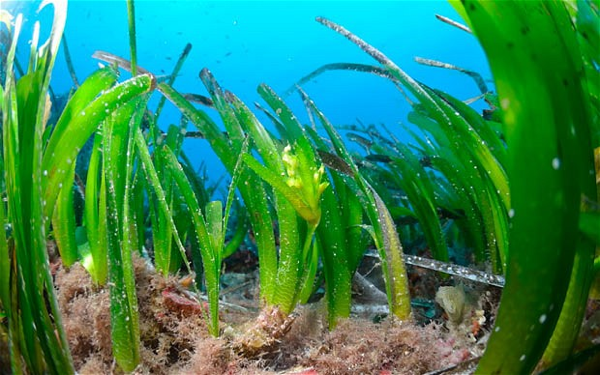
Great science story in the Telegraph today: a 'new' oldest group of organisms on earth has been found: they're somewhere between 12,000 and 200,000 years old (most likely around 100,000 years). Each spans 10 miles and weigh more than 6,000 tons! They're sea grasses in the Mediterranean, as here:

NewImage

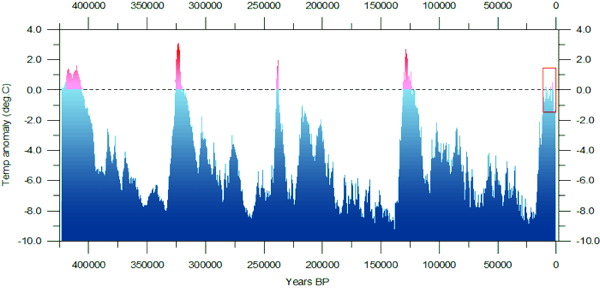
Great work by Professor Carlos Duarte of the University of Western Australia. Then he goes and spoils it all by claiming "If climate change continues, the outlook for this species is very bad". What? At 200,000 years, the things have lived through the better part of two full-blown ice ages! If they're over about 130,000 years old, they lived through the last interglacial, which was nearly 3ºC or about 5ºF warmer than today. See this temperature reconstruction from the Vostok (Antarctica) ice core:

NewImage

Even at 12,000 years old, they'd have seen some of the last full-blown ice age. And they'd have lived through the Holocene climate optimum (around 8,000 and 7,000 years before the present) and the Minoan, Roman and Medieval warm periods: all warmer than at present, as shown by this Greenland ice core:


NewImage

You don't get beyond your 12,000th (or 100,000th or 200,000th) birthday without being just a little bit adaptable [rolls eyes heavenwards].

Saturday, 14 January 2012

Words that make me gag

Is it just me, or has the phrase "policy maker" (even worse, sometimes the word "policymaker") gone from 0 to 100 uses per day on the BBC, and like media, in the last five years or so?

The most frequent use, it seems to me, is by self-righteous, self-styled "campaigners", lobbed softball questions on the Today programme, demanding that policy makers do this, that or the other thing, of which BBC-types would generally approve.

The very words make me retch. The implication is of a group of people, a class apart, possessed of preternatural ability, in dialogue with journalists and lobbyists, dreaming up things that are supposedly good for the hoi polloi. The only policy makers should be the self-same hoi polloi. The apparatchiks of political parties might offer up draft policies, for the consideration of the masses at election time or in referenda. But only the people should make policy.

My google searches on "policy maker" yield most mentions for members of the Bank of England Monetary Policy Committee and their counterparts at the US Federal Reserve. I'm not sure that much can be derived from google searches anymore, since they seem highly personalised, but certainly those people fit my definition very well, as people with executive authority who seem beyond democratic accountability. Their counterparts are now openly the unelected leaders of Greece and Italy, as nominated by Berlin, Paris and Brussels.

The price of freedom is eternal vigilance.

Tuesday, 27 December 2011

Marcus Brigstocke, comedian and propagandist

According to the comic‘s official website:

[BBC] Radio 4 has become a second home for Marcus.

Here‘s how he treats his audience (his emphasis, not mine), on the subject of climate change:

I could have written a two-hour stand-up show about climate change quite easily by now but there is absolutely no point because the only people who would come and see it already agree with me. So the approach I’ve taken is to drip feed it into everything that I do, whenever I’m on the radio or doing a stand-up show on any subject, to try and keep it in there just a little bit. People are on to me, it’s no sleight of hand — they know what to expect when I appear. In terms of creating comedy one of the easiest routes has been to mock the people who think that it’s not happening, because I find them easily mock-able. They will say a great deal but when questioned they haven’t read anything.

So, mouthy Marcus, drama degree dropout, reckons he‘s read and understood more relevant material than thousands of professional engineers who have had to understand the atmosphere in order to, you know, make things work (like me) and who happen to hold a contrary opinion (like me). Yeah, right! Still, our competing claims to expertise, and those of all others, are completely immaterial on any question of science: which is why the motto of the Royal Society is nullius in verba—roughly translated as “take nobody's word for it”.

The data is all that counts, and here's some, showing the global mean surface temperature (in so far as it can be calculated from a sparse set of thermometers), since 1995—during which time not a whole hell of a lot has happened. They won't tell you that on the British Biased Corporation. It’s more fun to let a smarmy smart-arse make fun of people who have a clue.

Saturday, 24 December 2011

British Biased Corporation

Today I want to draw your attention to an article on the BBC website, by its environment correspondent, Richard Black. I could have chosen any of hundreds of similar articles by Black and his colleagues over the last few years: characterised by lazy repetition of press releases from interest groups, in the promotion of solar and wind power; against a backdrop (in this case, implicit) of unquestioning acceptance of the anthropogenic global warming meme.

This time, Black has been fed by the Church of England (wouldn't you know) and the National Trust. They're whinging about the proposed cut in the renewables feed-in tariff (currently struck down on a technicality by the courts) from 43p to 21p per kilowatt-hour. By comparison, operators of coal, gas and nuclear power stations sell their electricity for 2-3 p/kWh (see Figure 1, here), while a domestic user can buy electricity at around 13p/kWh and an industrial user at around 8p/kWh (see Tables 5.4.2 and 5.4.3 here). So, if the government gets its way, if you stick a solar panel on your roof, you'll still be paid 7-10 times the rates of the commercial generators (on whom we actually depend), rather than the 15-20 times currently. A prime example of why the presumption should always be against subsidising anything. Give someone a free gift and they'll bellyache if the next one is a little less generous.

Who pays? Every domestic consumer to the tune of 10% of their bill by 2020 and businesses to the tune of 0.47p/kWh right now. So everything anyone (rich and poor alike) needs to buy costs more and everyone (rich and poor alike) will pay more for their electricity bills; all to the benefit of people who can afford the capital investment required to install solar cells and especially to the manufacturers thereof. This at a time when one in five households are said to live in a state of "fuel poverty" and in 2009/10 there was an excess winter death rate of nine pensioners per hour. And this at a time, of course, when the country is flat broke.

Does Black question who pays—with their money or their life? Does he put the subsidies in any kind of economic context? Does he question why we bother, when the mean global temperature has essentially flatlined for a decade or more? Of course not. His ex-colleague Alex Kirby gave the game away in one of the Climategate 2.0 leaked emails, to Professor Jones of the University of East Anglia (my bold):

Yes, glad you stopped this — I was sent it too, and decided to spike it without more ado as pure stream-of-consciousness rubbish. I can well understand your unhappiness at our running the other piece. But we are constantly being savaged by the loonies for not giving them any coverage at all, especially as you say with the COP in the offing, and being the objective impartial (ho ho) BBC that we are, there is an expectation in some quarters that we will every now and then let them say something. I hope though that the weight of our coverage makes it clear that we think they are talking through their hats

Which makes me think of another subsidy, of £3.4 billion raised by a poll tax, that the British public might be told what to think.

Friday, 23 December 2011

More from the bishop

Regular readers will recall my letter to Christopher Hill, the Bishop of Guildford.

The Rt. Revd. Hill did me the courtesy of a reply, and we exchanged subsequent letters. He requested that I not publish the subsequent correspondence, so, of course, I won't.

In general though, the bishop is not averse to publicising his views. Of course, one would assume that was mandatory for a cleric of a proselytising religion; but my attention was drawn to a piece in the Church Times which is almost wholly political (God and Christ are mentioned once each in a final paragraph that it is not related to the thrust of the article, and appears almost as an afterthought).

It appears that Rt. Revd. Hill chairs something called the House of Bishops' Europe Panel. The article follows David Cameron's refusal to cede parliamentary control of the British budget to European institutions, to allow a European tax on an industry that is predominantly situated in the UK, and to pay tens of billions of extra pounds to bail out eurozone banks and some eurozone countries (remembering, perhaps, that the eurozone taken as a whole is in a slightly better financial position than the sterling zone). The bishop opines "In the long term, it will be disastrous if we were actually isolated from the rest of Europe, economically and in terms of international relations", along with screeds of similar guff that I shan't repeat.

In other words, we should go along with whatever the leaders of France and Germany want, whether or not their own people want it, whether or not our people want it, whether or not we could ever recover our democracy, whether or not we are unfairly targeted for exactions, whether or not any of it will work on its own terms. And, as the argument goes, all to retain some "influence"—which the likes of Rt. Revd. Hill will always find reasons not to deploy.

The bishop makes no effort to suggest that his recommendations are those of which God would approve. His intervention seems wholly political. I am forced to the conclusion that monies placed on the collection plate subsidise prelates to push a political agenda that is not my own. And I'm afraid that thought trumps the blandishments in the bishop's private letters.

Wednesday, 21 December 2011

Johnny Euro plays catch up

At last: the European Central Bank has learned from the US Federal Reserve and the Bank of England!

As I understand events of the last 48 hours, Euroland banks about to go bust have been allowed to borrow hundreds of billions from the European Central Bank at next-to-no interest. Of that, they'll use hundreds of millions for their top directors to buy mansions, ski lodges, private jets, champagne, hookers, etc. The rest they'll lend to Club Med governments, with no particular expectation of getting it back. The risk of non-repayment will be borne by the ECB (also known as: the German taxpayer).

Nice work if you can get it!

Monday, 19 December 2011

The wrong ring fence

The chancellor of the exchequer, George Osborne, announced today that he intends to implement the main recommendations of the Vickers report; in particular, that banks should 'ring fence' retail banking operations from investment banking, which is perceived to be riskier. This is justified in the Vickers report by the claim that:

it would insulate vital banking services on which households and small and medium-sized enterprises (SMEs) depend from problems elsewhere in the (global) financial system.

Of course, that would be laudable. We wouldn't want nefarious casino bankers frittering away the savings of thrifty British workers by placing losing bets on complex derivative functions of various obscure foreign assets; thus unable to provide mortgages to “hard-working families” (I apologise for reminding readers of one of Osborne's illustrious predecessors) or working capital to hard-pressed small businesses. There is only one flaw in this argument: the banks that went belly-up in the UK in 2008—Northern Rock, Bradford & Bingley, Alliance & Leicester, HBOS, Lloyds, RBS—were exclusively or primarily retail banks; who were brought down by betting that they'd make a return on 125% self-certified mortgages (and the like) to Joe and Jane Public. So this particular ring fence would protect the bonuses of City wide-boys and fat cats from the delusions of overly-optimistic twenty-something house-buyers and whoever runs the computers that lend to them.

The terrifying thing about the 2008 crisis was the imminent threat that banks would conserve cash by halting payments to other banks representing normal commercial transactions, such as salary and trade payments; at which point everyone would be unemployed in short order. It is around the safe custody of money, and the transmission of money between safe-custody accounts, that a ring fence must be built. This is a low-risk, well-understood business with predictable costs.

On the other hand (or the other side of the fence), buying and holding financial assets, whether Joe Public's mortgage or Greek bonds or some derivative thereof, is inherently risky, especially under the fractional reserve system where my bank deposit might be used several times over to back such purchases. I'm very uneasy that money intended to pay housekeeping or wages or otherwise lubricate the wheels of commerce is used in these ways, without any explicit choice by the depositor. If I have spare money, which I want to bet on a risky venture, well and good, but it should be explicit, with my eyes open.

Of course, to erect such a fence, a very British sacred cow, standing in the way, will need to be slaughtered: the idea that banking should be free. If you want your money genuinely looked after (in a secure computer, in a vault), and not used as a poker chip by an anonymous gambler, I'm afraid it costs. So does moving it securely between vaults. And converting it to paper spewed out of a wall. I should know, because it's my business.

One other thing about Osborne's proposals: he wants them implemented by 2019. As Margaret Thatcher used to say to civil servants, World War Two was nearly lost and then won in less time. The nuclear bomb of Club Med default is almost certain to go off a lot sooner.

Wednesday, 30 November 2011

Today's public sector strike

A copy of a post I made on a forum, on today's strikes. It got a lot of endorsement there.

–––––––––––––––––––––––––––

xxxx wrote:
yyyy, to be honest its not about whats sustainable is it. 

We are paying back the cash the bankers spunked and wasted and we bailed them out.


That's not really the whole truth, is it?

The previous government went on an accelerating spending spree from about 1999 to 2008, hiring like crazy (and of course, for each and every new hire, making promises it had no idea could be kept by future governments concerning pension "rights"). They stoked up an artificial boom by allowing the banks to create stupid amounts of credit, and raked in their share of the new money via taxes on the banks' profits (not profits in any normal sense of the word, just the proportion of their newly created money they kept for themselves). But that still wouldn't fund all the previous government's schemes, so they borrowed directly, piling debt upon debt. When the party came to its inevitable conclusion, the spending programmes were still in place but taxes on bankers' profits dried up. That effect was far greater than the direct bailouts of banks carried out by the previous government. zzzz and I (and a couple of others) actually bottomed out the figures and amazingly came to a measure of agreement, because the figures spoke for themselves.

This leaves us in a position where the government is spending more on debt interest that on defence. And they're not even planning to reduce the debt: only to lessen the rate at which extra debt is accumulated. If our government had to pay the same rate of interest as Spain or Italy (which is surely a possibility), then interest payments would be more than spending on education, and in all probability the debt could never be controlled without inflation destroying everybody's savings (eroding steadily already via 5% inflation).

So it IS about sustainability and NOT about bailing out the banks.

Now, workers in big companies have seen their final salary schemes vanish, or at the very least closed to new entrants. Workers in small companies never had such schemes. They've seen contributions they've already committed, under a set of assumptions about tax, being subject to ongoing tax raids. They've seen the stock market stagnate at best, so their pension pots are not growing at the rate they might have anticipated. They've accepted contribution holidays when their companies go through bad times (and sometimes when they're not). They've seen their companies and their pension schemes go bust. This has been the warp and weft of private sector existence for decades. And even if the government backs down now, the worst of this could happen to you: a future government, not very far down the line, might run out of money to pay your pension.

So while I don't regard everyone in the public sector as a waste of space, it's your turn for pruning and you need to realise that previous governments have made promises that cannot be kept, and suck it up like (nearly) everyone else. Meanwhile, you might google the sacrifices that have been made in the public sector in Ireland: without much complaint, because there's a sense of grim realism there.


Thursday, 24 November 2011

It's just not cricket!

Can this be true?

We [the England and Wales Cricket Board] also have to comply in 2012 with the IOC’s requirement that no other international sport can be staged during the Olympics and Paralympics.

http://www.telegraph.co.uk/sport/cricket/8912828/Test-cricket-will-only-thrive-if-matches-remain-enthralling.html

Who says? Can the British Olympic Association, or any of the myriad quangos that seem to have been set up to run the London games, bind the ECB (and all other sporting bodies)? I don't see how. Or has Cast Iron Dave or Broon or Bliar before him passed a law while no-one was looking?

I call upon and any of my American, Australian or French friends or relatives to help me flout the decree of Count Jacques Rogge, by challenging me to a game of Real Tennis at Hampton Court Palace next August. I feel sure the ghost of King Henry VIII will protect me: he knew how to treat foreign potentates who would make laws in our sceptred isle; especially when it came to restricting his right to engage in fun and games with whomsoever he pleased.

The Leveson Inquiry…

…is explained here.

It consists of four "modules":

  • Module 1: The relationship between the press and the public and looks at phone-hacking and other potentially illegal behaviour
  • Module 2: The relationships between the press and police and the extent to which that has operated in the public interest
  • Module 3: The relationship between press and politicians
  • Module 4: Recommendations for a more effective policy and regulation that supports the integrity and freedom of the press while encouraging the highest ethical standards.

Confusingly, the terms of reference are in two parts; with no obvious mapping between the parts and the modules. Apparently, 'Cast Iron' Dave expects Part 1 of the inquiry to be completed within one year. It seems it's 'too soon' to provide an estimate for the inquiry's cost. Personally, I can't remember starting a project without an estimate for the cost. But then I'm either using my own money or persuading someone who takes a close interest to part with theirs. I don't suppose Lord Justice Leveson comes cheap; nor his six assessors nor his five counsels for the inquiry. It's a pretty nice website too.

So, I will make a submission to the inquiry, giving the following answers free, gratis, and for nothing:

  • Module 1: The press writes anything that might interest readers and the public buys the papers. Or the canny ones read them on the web. Or the cannier still find out what's really happening from blogs. The press has hacked phones and has potentially engaged in sundry other potential crimes (allegedly).
  • Module 2: The police treat phone hacking in much the same way as other crimes, such as burglary. That is, they might go through the motions. They'll tip the wink to the press if they come across anything juicy, in return for a spot of corporate entertainment, or a good word in an editorial. The public is not particularly interested.
  • Module 3: Politicians will do anything to get a favourable mention from the press. The press will do anything to expose the hypocrisy of politicians (not a lot of effort is required there), which is its most useful function.
  • Module 4: The press has very little integrity to support. 'Effective policy and regulation' and 'highest ethical standards' is code for stopping the press from snooping on politicians. Don't fall for it. We don't need any more laws or regulations; we've too many to enforce anyway and the police will always excuse laxity by saying they're too busy enforcing the laws on the curvature of suggestive fruit and vegetables, or something.

Finally, Leveson has granted himself the right to hold parts of the inquiry in private, at his discretion. Please, your honour, do so for the never-ending stream of people famous for being famous whining about being caught screwing someone they shouldn't. The papers made you rich and famous, but it's you who make yourself embarrassed. I don't care what the European Convention says, there's no natural right to privacy. In a state of nature, if someone turns up at your cave and tries to steal the deer you've just killed, you have the right to assail him with your cudgel. If you're spied behind the bushes with your neighbour's wife, that's just too bad.


Monday, 21 November 2011

A short-term memory lapse


According to reliable sources, the government has decided that I am to underwrite mortgages for people who can't afford to buy a home. Apparently, this will "give many more people the satisfaction and security that comes with stepping over their own threshold". Satisfaction? Has the government forgotten that borrowing in the cause of instant gratification has brought us to this pass? Security? Has it forgotten that it already has one trillion pounds of debt, growing at about £150 billion per year? That it has unfunded liabilities for public sector pensions of another trillion pounds? Of another quarter of a trillion in PFI liabilities? That countries whose underlying finances are in no worse shape than the UK's are paying 7% interest to fund their borrowings—which would blow the economy to kingdom come? That in a country called the United States of America, this ruse has already been tried, ending exceptionally badly for a couple called Fannie and Freddie?

But at least this won't bother some hard-pressed taxpayers—because the government has decided to outright gift £400 million from the rest to property developers (who prospered so well during the Blair/Brown years); a sort of inverse Robin Hood tax.

I have a simpler plan to help first-time buyers: why not allow house prices to fall to a new market level, from the preposterously inflated level caused by a decade of lax monetary policy? Then, in the unlikely event of taxpayers having any spare cash, they might invest it themselves to fund the growth of productive enterprises, which is the only hope for digging ourselves out of this mess.

Sunday, 20 November 2011

Dear Bishop

Bishopchristopher

An open letter to the Bishop of Guildford

Dear Bishop,

I write concerning the letter that you and sixteen fellow bishops had published in the Observer today.

It condemns, rather high-handedly in my opinion, the coalition government's Welfare Reform Bill, which would limit the amount any household might claim in state benefits to £500 per week (a figure that you omit from your letter). According to Wikipedia, this is some 65% above median UK household income.

This seems to be the latest in a series of pronouncements from senior Church of England clergy condemning the government's policy of bringing public spending under control after a decade in which it has grown sharply.

You invoke the church directly, and speak of a moral compulsion. Since I profoundly disagree with you, I wonder if my economic and political views are nowadays compatible with church membership. Perhaps you could let me know whether, in your opinion, the following views conflict with Christianity:

  1. that welfare benefits should not be on a ratchet drive, only ever increasing, whatever the country's circumstances;
  2. that above a certain level, spending on welfare will reduce incentives to work harder, or at all, diminishing the nation's total wealth, with the poor inevitably hardest hit;
  3. that paying people who do not work more than the majority of people that do, is morally wrong;
  4. That any family can live reasonably on £26,000 a year.

In the event that these views are not wholly incompatible with Christianity, I would ask you to consider that the barrage of political interventions by the bishops might alienate a large number of natural Anglicans. If you are comfortable with that, perhaps you might recommend a denomination in which people like me would feel more welcome.

I have published this letter on my blog; with your permission, I will also publish any reply.

Yours sincerely,

Neil McEvoy

Pyrford, Surrey


Saturday, 19 November 2011

Basil d'Oliveira

BdO

Rest in peace.

d'Oliveira was a superb all-round cricketer for Worcestershire and England in the sixties and early seventies. In particular he was a brilliant player of fast bowling: like all great players of ball games, he seemed to have so much more time to play the ball than the merely good. I had forgotten that he had not been picked for England until past his athletic prime, at 35. Yet still he played 44 test matches with a batting average of 40.06. For those who are not in the know, a test career average of 40 or above marks out an outstanding international batsman from a very capable one. It would surely have been much higher if he'd been picked at 25 rather than 35. He batted with minimal back lift, but was able to punch the ball through the gaps with powerful, well-timed strokes. Although Dolly was a batsman who could bowl, rather than a genuine strike bowler, he was often called upon to winkle out batsmen who were set. He could swing the ball either way (at modest pace) and was extremely accurate and therefore economical.

I remember him too for being a sportsman in the fullest sense of the word, a fierce competitor but true gentleman, demonstrating grace under pressure on and off the field. Certainly, an example that modern professional sportsmen would do well to follow.

Of course, the reason he was not picked earlier was that, as a Cape Coloured, he was in essence an economic refugee from apartheid South Africa, where opportunities were denied to non-white sportsmen. The South African government's outrageous refusal to allow him to tour with the English team in 1968 led to more than twenty years of cricketing isolation for them—at a time when South Africa, with greats such as Graeme Pollock, Barry Richards and Mike Procter, would have been world beaters. So many careers wrecked in the name of politics. Conceivably, that shortened the life of the apartheid regime and led to a relatively bloodless transition.

I am slightly aggrieved that the BBC News bulletins today have only dealt with the impingement of politics on d'Oliveira's career. That is to dwell on the man's circumstances rather than his character and achievements, which were exemplary.